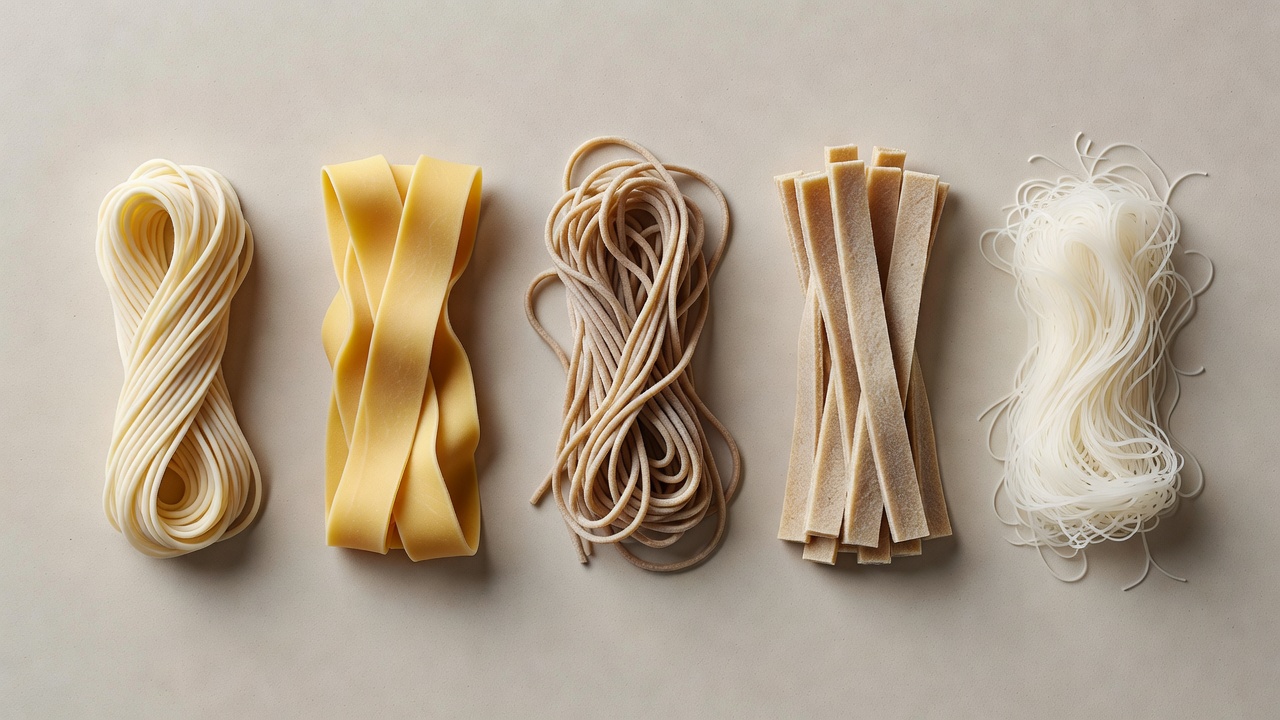
Walk from northern China's Yellow River plains to southern wet-rice river deltas, across the Sea of Japan into mountain buckwheat valleys, or north to Bologna's arcaded streets, and you see immediately why speaking of "noodles" as a single category misses the story. A noodle is a local agricultural archive. Where winter wheat dominates dry upland soils, cooks developed high-gluten pulled, shaved, and hand-cut strands. Where warm, water-rich lowlands harvest rice twice a year, cooks perfected soaked-grain slurries steamed into translucent sheets or extruded directly into simmering kettles.
Northern China: Shaanxi Belts and Shanxi Blades
In Xi'an and across Shaanxi Province, wheat is celebrated for dramatic elasticity. Cooks brush resting logs of dough with neutral oil, flatten them with a pin, press a seam down the centre with a chopstick, and slap the stretching ribbon rhythmically against timber—producing the unmistakable thwack that gives biangbiang mian its folk name. Finished with crushed garlic, roasted chili flakes, and a sizzling spoonful of hot rapeseed oil (youpo), each wide belt acts as a chewable canvas for black vinegar and crisp greens.
Directly northeast in Shanxi Province, cooks treat flour with surgical sculpture. As food writer Fuchsia Dunlop notes in her reporting on regional Chinese kitchens, Shanxi boasts dozens of distinct wheat-shaping methods: oat-flour honeycombs (youmian kaolaolao), cat's-ear shells rolled off a thumb, and iconic daoxiao mian, where a stiff dough pillow rests on one forearm while a curved steel blade shaves tapered triangular ribbons straight into boiling water. That triangular cross-section cooks tender along its thin edges while staying delightfully firm down its spine.
Southern China & Southeast Asia: Duck Eggs and Aged Rice
Travel south to Guangzhou and Hong Kong and wheat shifts texture again. Traditional Cantonese jook-sing (bamboo-pole) noodles blend high-protein wheat flour with rich duck eggs and alkaline jianshui, then compact the stiff dough beneath a thick bamboo pole ridden like a seesaw. The result is an impossibly fine, springy golden noodle prized for a crisp bite that resists swelling inside clear dried-flounder and pork-bone wonton broth.
Across Vietnam and Thailand, rice—not wheat—anchors daily noodle life. Aged long-grain rice, lower in sticky amylopectin than fresh harvest rice, is soaked, wet-milled into liquid batter, and steamed over taut cloth drums. In Hanoi, those tender white sheets are folded and sliced into flat bánh phở; in Penang and Bangkok, wok-ready rice ribbons meet smoky cast-iron heat or tangy tamarind-fish broths like assam laksa without ever losing their delicate slip.
Japan and Korea: Buckwheat Mountains and Knife-Cut Comfort
Japan treats noodle genres as separate crafts with distinct apprenticeships. In Nagano's cool mountain basins—historically Shinshu—buckwheat thrives where wheat struggles. Because buckwheat contains zero gluten, classic ni-hachi soba combines eighty percent stone-milled buckwheat with twenty percent wheat flour, bound rapidly with cold water and cut with a heavy straight-edged sobakiri knife so cleanly that every square strand stands sharp on a bamboo zaru mat. Meanwhile, Kyushu's Hakata ramen relies on taut, thin alkaline wheat noodles cooked for less than forty seconds, whereas Fukushima's Kitakata ramen uses high-hydration hand-massaged wavy ribbons.
On the Korean peninsula, seasonal contrast defines the noodle calendar. Winter invites kalguksu—literally "knife noodles" cut from a soft wheat sheet and simmered straight into clam or anchovy-kelp stock so the starch gently thickens the broth. High summer calls for Pyongyang- or Hamhung-style naengmyeon, chewy buckwheat or sweet-potato-starch noodles served in icy beef or radish-brine dongchimi broth that cuts through July humidity.
Italy's Regional Pasta Table: Soft Egg Dough vs. Durum Semolina
A faithful noodle publication also honours Emilia-Romagna and Puglia without blurring them into East Asian idioms. In Bologna, as Marcella Hazan and modern pasta craftsman Evan Funke emphasise, soft Tipo 00 flour and deep-orange egg yolks are rolled purely by hand across a wooden board with a long tapered mattarello. The rough timber scuffs the pasta's surface at a microscopic level so slow-simmered ragù clings to every ribbon of tagliatelle. South in Puglia, where dry heat favours hard durum wheat, cooks skip eggs altogether—kneading semola rimacinata with warm water and dragging thumbs across tiny dough nuggets to shape cupped orecchiette built to trap bitter broccoli rabe and olive oil.
Regional Comparison Reference
| Region | Signature Noodle | Grain & Binder | Serving Rhythm |
|---|---|---|---|
| Gansu | Lanzhou lamian | Wheat + plant ash alkali | Pulled to order in clear spiced beef broth |
| Sichuan | Dan dan mian | Fine round wheat or light alkali | Tossed dry over sesame, chili oil, and ya cai |
| Nagano | Ni-hachi soba | 80% buckwheat, 20% wheat | Chilled on bamboo with soy-dashi dipping tsuyu |
| Seoul | Kalguksu | Soft hand-cut wheat | Simmered directly in clam or chicken stock |
| Emilia-Romagna | Tagliatelle | Tipo 00 wheat + whole eggs | Finished in pan emulsion with butter or meat ragù |
Next Chapter
How broth, tare, and aromatic oils complete the bowl
A handmade noodle never tastes finished in isolation. Explore how cooks pair surface texture with seasoning bases, dashi clarity, and toasted chili oils.
Build the bowl around its noodles